
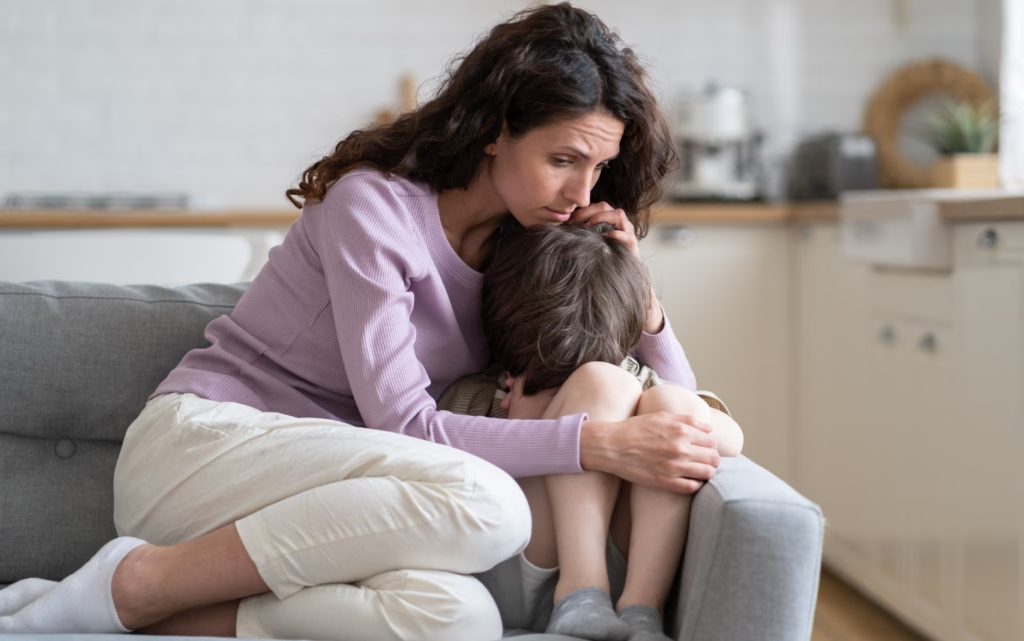
A toddler rolls around on the floor during circle time and wails. A kindergartner refuses to line up because he wanted to be the leader. A three year old bites a friend over a shared toy. These moments happen dozens of times a day in early childhood classrooms, and how a teacher responds to them matters more than most training programs ever explain. This is where the Four S’s of attachment come in.
Psychiatrist Dan Siegel and psychotherapist Tina Payne Bryson describe secure attachment as the product of a child feeling Four S’s consistently: seen, soothed, safe, and secure. Teachers are just as important as parents in forming secure attachments in children. Those experiences accumulate from every caring adult in a child’s life, and for many children, a teacher is one of the most consistent, and healthy, adults they have.
Because teachers have taken classes in child development. Most parents have not! It’s wild you have to take classes to become a teacher, but not a parent!
What does it mean to feel seen
Seen means attuning to a child’s inner world, not just their behavior. You look being what a child is “doing” on the outside and become curious about what is “happening” on the inside.
Pause there. Did you take that in?
When I was a teacher, and now as a classroom coach, I notice adults only commenting on the child’s behavior. Completely ignoring the child’s inner world.
Inner world means their mental activity: thoughts, perceptions, beliefs, body sensations, and feelings/emotions. Yes, all that is mental activity; meaning, your mind is making meaning out of things. Teachers need to tune in to that meaning to help the child learn how to replace challenging behavior with adaptive behaviors.
How often do you, the adult, attune to the children in your classroom’s interior landscape? Do you pause to ask them about their mental activity as described above? Meaning you interpersonally attune, or are you only asking them to listen to your mental activity or to consider other children’s only?
This happens a lot with adults. We say, “Look how you made him feel,” or “Patrick is cleaning up you should be too,” or “I need you to clean up and come to circle.” Notice none of these statements involve the child sharing their thoughts, feelings, beliefs, sensations, or perceptions. You did not interpersonally attune to the child. You had them tune in to everyone else.
And in this country anxiety has outpaced depression as the number one mental health concern. Anxious adults have difficulty regulating their emotions. Not surprising if no one ever pauses to help them make the u-turn inward and notice, name, then tame their emotions.
Children will have more challenging behavior if you fail to consider their interior landscape.
Why?
Because children cannot self-regulate fully on their own. They need, not want, an adult to provide co-regulation to keep their mental activity in balance. And how can you co-regulate if you have no idea what is going on inside them? You need to look beyond the form of the behavior (biting, punching, kicking, spitting, running, not talking, isolating, etc.) to what is going on inside them!
From being seen, they start to feel soothed and safe.
Providing Soothing for the Child
Soothed means a child learns they do not have to manage big feelings alone, their nervous system starts to return to balance, and that they trust a calm adult will stay with them to help them with this process.
Children need to borrow from our fully developed brains to help them manage the big feelings of their underdeveloped brains. Don’t expect children 0-5 to self-regulate. They need, not want, co-regulation from you.
Because the part of the brain that helps with regulation doesn’t develop, it’s currently believed, until THE MID-THIRTIES!!!!!!!
Another way to think of soothing is nervous system regulation. When children feel seen and soothed, their nervous system becomes regulated, and challenging behavior is less likely to occur. Stands to reason, then, if we want a peaceful classroom or home we will help children feel seen and soothed.
But please level set expectations: children will always have challenging behavior. It is natural because their brains are not fully developed. And, when you think about it, don’t you know adults who have challenging behavior? Their brains are fully developed and yet they still act out. Maybe remember this the next time a child is misbehaving so you can access some compassion for them.
Seeing and Soothing Through Interpersonal Attunement
Seeing a child does not mean simply watching them. It means interpersonally attuning to the child; the practice of tracking what is happening behind a child’s behavior rather than reacting only to the behavior itself.
A child who throws a block is not simply being disruptive. Something is happening in that child’s nervous system. It might be frustration, overstimulation, skills that are lacking, or a need that has not been met.
Interpersonal attunement involves the teacher becoming curious about that underneath layer before responding to the surface layer. Helping the child make that u-turn inward.
Soothing follows attunement.
Once a teacher has a sense of what a child is actually experiencing, soothing means helping that child’s nervous system settle, through tone of voice, physical presence, pacing, and language that communicates I am here and this feeling makes sense.
Soothing doesn’t come from adults telling children to calm down, or that they are not listening or they know better. Would that make you feel better if I came into the classroom and said any of those things to you amidst a challenging moment with a child?
Nope. I didn’t think so! Instead, you need to attune. But how?
Five Active Listening Skills That Build Attunement
Interpersonal attunement is not an abstract mindset. It is built through specific, learnable skills. The following five active listening skills give teachers concrete language to use in the exact moments described at the start of this article.
Mirroring
Mirroring means reflecting back what a child says or expresses, in exact words, so they know they have been heard accurately. If they are non-verbal, or just not using words in the moment, you might make a guess as to what they are expressing.
Example: A child says, “I don’t want to clean up, I’m not done!” A teacher mirrors, “You don’t want to clean up yet because you aren’t done, huh?”
What does that do? It helps the child know you see them! And, it helps them notice and name what they are thinking so they can start to tame those thoughts and feelings because they are going to clean up.
They might follow with, “Yeah, it’s not fair! I am so close to finishing my tower. I’m mad! I don’t want to clean up.”
Summarizing
Summarizing means pulling together the key points of what a child has communicated, often after several sentences or a longer emotional moment, to show the whole picture has been understood, not just the last thing said.
Example: “I get it. You’ve worked so hard on your tower and you are close to finishing. It is so hard to stop when you want to keep going. You are feeling mad. Did I get it?
That summarizes the child’s perspective. And, you are a signal of welcome because you aren’t just saying “it’s time to clean up, you know the rules.” Where does that normally get you?
Attuning is signaling to the child: you matter. We are still going to clean up AND you matter.
Empathizing
Empathizing means naming and joining a child’s emotional experience, rather than staying neutral or moving straight to a solution. It communicates that the teacher understands not just what happened, but how it feels.
Example: “You make sense that you are mad, Jacob. You worked so hard on your tower and time ran out. You can be mad at that. That is okay.”
Validating
Validating means confirming that a child’s feeling makes sense given their experience, even if a teacher would not respond the same way, and even if the behavior that followed still needs a boundary. Validating does NOT mean you agree with the child or their behavior. It means, “I see you.”
Example: “You make sense because you had your work all planned out and I noticed you had to wait for some of the duplos you needed for your tower. You waited so patiently and then the music went on for clean up time! Ugh. No wonder you are upset.”
Asking Open-Ended Questions
Open-ended questions invite a child to say more, rather than answering with a single word or a yes or no. They give a child room to keep processing instead of the adult filling in the meaning for them.
Example: After you mirror, summarize, empathize and validate, involve them in coming up with a solution with open-ended questions. It might sound like, “Hmmm…what do you think we can do about this problem?” They might say, “let me have more minutes,” to which you might reply, “gosh, we have to clean up now, but what about if we save your creation on the table and you return to it after lunch?”
In this way, you are again a signal of welcome, you are collaborating with the child based on their perspective, and you are still being firm with your boundaries/limits. Both/and.
Embedding Attachment into the Classroom Routine
None of these skills require a special block of time set aside in the day. They fit inside transitions, conflicts, meltdowns, and even celebrations, which is part of what makes them realistic for a classroom with one adult and many children. A teacher does not need to use all five skills in every interaction. Even one, offered consistently, moves a child toward feeling seen and soothed.
It also helps to remember that attunement is not about getting it perfect. Children do not need flawless responses every time. They need a caring adult who shows up predictably, repairs when a moment is missed, and keeps trying. That predictability, more than any single perfect interaction, is what builds trust over a school year.
How to promote Safety in Children
A sense of safety results in a child’s body and mind being in balance. This happens when the environment is predictable, consistent, and free from threats, shaming, blaming, yelling and other toxic adult reactions. And, when teachers understand how to consistently attune to children.
Safety is not just keeping their bodies safe; but rather, you are also attending to their minds. Meaning, safety is both physical AND emotional. Emotional safety means they are expressing their emotions in healthy ways and they are able to come to a place of regulating those emotions with the adult’s help.
Having a consistent schedule, preferably visual and posted at their eye level so they can interact with it, helps children predict what comes next and to adapt when changes in the schedule must occur. You avoid children becoming anxious, which can be emotionally unsafe, when they don’t know what happens “next.”
The teacher changes the visual from a picture for outside time to a picture of a special visitor from the zoo. Instead of just telling them there will be a change, you show them. This may prevent emotional dysregulation.
Safety also comes from clear physical boundaries in the classroom (no wide open spaces where they can run), and knowing where toys, materials, and supplies go. Labeling shelves, having materials at children’s eye level, and having enough materials for children to share all helps children navigate their “work” of gathering materials, playing with them (their work), and then putting them away.
When that is not in place, teachers might ratchet up the directions and corrections “put your legos in the bin/stop running in the classroom/stop fighting over the toys, use your words, etc.” This results in a classroom that feels chaotic and chaos is not safe.
Finally, the teacher is a huge part of the environment. Your words, actions, and body language help children either feel safe or threatened. If a child is repeatedly acting out with a specific teacher, it could be a result of not feeling safe with that adult. They “lash out” because you are perceived as a signal of danger. If that is happening to you, try to uplevel your attuned engagement.
Challenges are prevented, in part, by creating this type of environment where the child feels safe to move about the room, knows how to engage with the materials appropriately, and trusts that the adults in their room are safe havens for them to turn to when they feel challenged.
What This Gives Children Long Term
When you commit to seeing, soothing, and creating safety for the children in your room, day after day, you are giving them something most adults never got themselves: a nervous system that expects care instead of chaos. That is what security, the fourth S, actually is. Research backs this up: kids with secure attachment regulate their emotions better, build stronger relationships, and bounce back faster from hard moments for the rest of their lives.
You do not have to attune perfectly in every moment. Nobody does, including me, even after years of doing this work.
What you are building is a pattern, a felt sense in that child’s body that says, this adult sees me, this adult helps me, this room is safe. That pattern is worth more than any lesson plan you will ever write, and it is still there long after a child has forgotten what happened at circle time.